
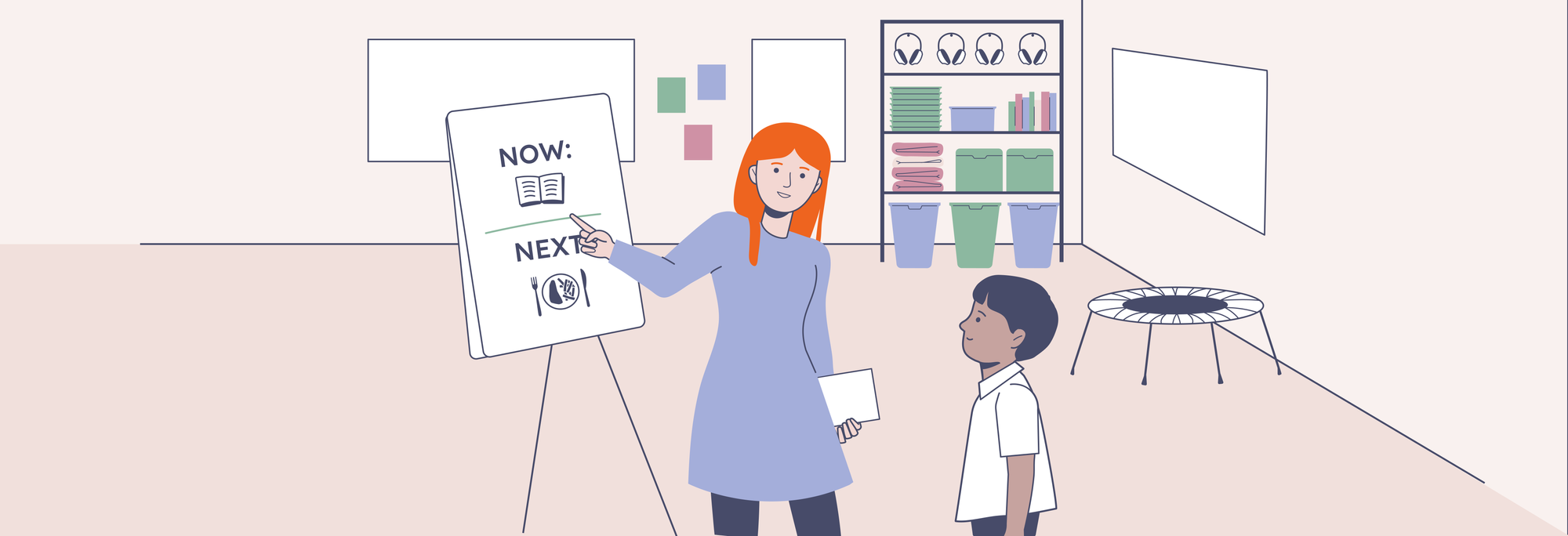
Developing teaching for students with complex needs in specialist and alternative provision
Resources|4th November 2026
Content Lead — Steplab
What does great teaching look like in specialist and alternative provision? Abby Williams explores how shared teaching principles can be adapted for pupils with complex and additional needs, and how PD can help teachers build adaptive expertise.
It’s a Wednesday morning and a science lesson on shadows is underway. A teacher kneels beside a student who is jumping around in his chair. “You’re excited!” she says. “What do you want? I want…” She holds out his communication board and waits.
After a moment, he points to the symbol for “on”.
“You want the torch on,” she says. “Push the button.”
She points at the button on the torch and hands it over. He pushes it and the torch lights up.
“You pushed the button to turn the torch on!” she narrates.
Now he’s ready to use the torch to explore shadows with the rest of the class.
In this brief exchange, the teacher draws on a wealth of knowledge: how best to respond to his excitement, how this student communicates, how to support processing and how to make learning concrete and memorable.
It’s the kind of expertise teachers in specialist schools and alternative provision (AP) settings draw on every day. Their work is skilled and demanding: supporting children with complex needs to feel safe, confident and valued, and helping each child make progress from their starting point.
So how can every teacher in a specialist or AP setting develop this expertise?
That’s the question we set out to explore with leaders from across the sector.
What’s distinctive about specialist and alternative provision practice?
The foundations of great teaching apply to all children. Every teacher needs to make their students feel safe and valued, help them pay attention, ensure they understand information, and encourage them to think.
But when children face more numerous and more intense barriers to learning, the strategies for achieving these goals often look different.
So we asked specialist and AP leaders which areas of practice they saw as most valuable and distinctive for teachers in their settings. Their answers became the 10 goals of the PD curriculum they helped us to develop:
- 1.Preparing sensory-safe environments.
- 2.Using knowledge of students to build belonging.
- 3.Building structure and routines.
- 4.Promoting positive behaviour and regulation.
- 5.Gathering, maintaining and redirecting attention.
- 6.Practising accessible communication.
- 7.Making learning memorable.
- 8.Teaching new vocabulary.
- 9.Supporting learning in all interactions.
- 10.Working with support staff.
That’s not to say these are the only things that matter. Other practices matter just as much, but leaders felt they look similar enough across settings that teachers can learn directly from our Core curriculum. Therefore, this first version focuses on the 10 goals above.
From goals to steps
Broad goals like ‘gather, maintain and redirect attention’ are easy to recognise as important but harder to translate into classroom practice.
Teachers achieve these goals through many small, specific moves: action steps. Naming those moves makes expertise something you can observe, rehearse and use in your own classroom.
For example, some of the strategies specialist and AP teachers can use to ‘gather, maintain and redirect attention’ are:
- 1.Using clear and memorable routines for getting attention.
- 2.Using students’ names.
- 3.Using sensory props.
- 4.Using visual cues.
- 5.Varying their voice.
- 6.Pausing mid-sentence, or using a ‘self-interrupt’.
- 7.Using redirecting questions and invitations.
These steps aren't a script to be followed in the same way every time. They're a toolkit of strategies a teacher draws on and combines based on what's happening in the room with this particular student, on this particular day.
The teacher with the torch, for example, was responding to the student, not working through a checklist.
Knowing when to use, say, a self-interrupt rather than a visual cue is the adaptive expertise that PD needs to build. But if the right move depends on the student, can a single set of steps really help?
Responding to each student
Children and young people in specialist and AP settings have very different needs, and what works for one might not be right for another.
But the variation isn’t only between settings. Even a single provision with an autism specialism caters to children with a range of communication styles, sensory profiles, additional diagnoses and personal histories. So a curriculum organised around diagnoses or types of setting wouldn't solve the problem either.
Instead, we separated the core principles of each strategy from the ways it can be applied.
Take ‘greet warmly’, one of the action steps for building belonging. The underlying principle is the same for every student: engage with them in a way that shows you see and value them.
But the success criteria beneath it spell out that this can look very different depending on the child. For example, in ‘match energy’, the criteria outline that this could involve crouching to eye level for one student, a quiet nod without demanding eye contact for another, and a high-five or secret handshake for a third.
The range of options encourages teachers to respond thoughtfully to each individual student, rather than assuming a diagnosis dictates a single approach.
These examples come from leaders' own practice working with students who have different profiles of need, but they aren't an exhaustive list, and no set of examples could capture every child.
Instead, they're a starting point for the question teachers ask every day: “What's the best way to apply this principle for this student, in my classroom?”
Knowing your students is built into every goal and step so teachers can observe, reflect and adapt.
“Each of our class groups learn in completely different ways so it was very useful for the goals to feel like they support this, whilst having consistent ‘values’ for every class to focus on.”
Sophie Law, Teaching and Learning Lead, Pencalenick School
The same strategies in different specialist and AP classrooms
Models help teachers see strong practice in action, but models are most helpful when they reflect a teacher’s own reality.
A video of brilliant practice in a mainstream secondary classroom can be hard to apply when you teach five children with complex sensory and communication profiles.
Every model video in this curriculum was filmed in specialist and AP classrooms, with students who have a range of complex and additional needs: over 200 clips from more than 30 lessons.
These aren’t staged demonstrations. They’re live footage, captured on an average Tuesday morning or Thursday afternoon.
And most steps are shown in several settings, so teachers can watch the same strategy in, say, an early years pre-formal class, a sixth form practical session, a secondary maths lesson and a one-to-one phonics session, and see both what stays the same and what changes for different students.
We’re very grateful to the staff we filmed at Silverwood School, The Springfields Academy, West Lea School and Ormiston Bridge Academy.
Developing practice in your own setting
For many teachers, PD means a training day or a course. These inputs can build valuable understanding, but on their own they rarely change what happens in the classroom.
Knowing in theory that students in specialist and AP settings need time to process isn't the same as pausing, reliably, after asking a question, even when a child is bouncing in their chair.
That kind of change tends to come from small, regular cycles: watching a short clip, naming the specific move, rehearsing it with a colleague, trying it with your own students and getting feedback on how it went.
Every setting fits this more embedded approach into their timetable differently, from weekly staff sessions and daily class-team briefings to one-to-one coaching.
The Specialist and AP steps are designed to slot into whichever rhythm works best for each school.
Developed by leaders across the sector
The curriculum was shaped by practising headteachers and senior leaders from specialist and AP settings, who wrote the content, opened their schools for filming, and piloted the steps with their colleagues. We really appreciate them sharing their expertise and insights.
Content developed by
- 1.Josh Hamblin, Head of Campus, Silverwood School.
- 2.Jon Kulas, Head of School, Ormiston Latimer Academy.
- 3.Alex Miller, Vice Principal, Ormiston Latimer Academy.
- 4.Laura Parker, Head of School, Charlton Park Academy.
With thanks to
The teachers and leaders who shaped the steps through focus groups, filming or piloting the curriculum with their colleagues:
- 1.Nicola Brooks, Deputy Headteacher, The Springfields Academy.
- 2.Steve Cooper, Deputy Headteacher, Kickstart Academy.
- 3.Tanveela Haidar, Head of Curriculum Development, West Lea School.
- 4.Alice Henderson, Assistant Headteacher, Cleave Meadow School.
- 5.Ben Hughes, Associate Assistant Headteacher, Queensway School.
- 6.Christina Kallianezou, Head of Children's Functional Vision Impairment, Joseph Clarke School.
- 7.Sophie Law, Teaching and Learning Lead, Pencalenick School.
- 8.Laura Moyse, Assistant Headteacher, Hob Moor Oaks Academy.
- 9.Robyn Seward, Marches Academy Trust.
- 10.Leanne Stokoe, Trust Wide Leader, Learning in Harmony Trust.
- 11.Loredana Vaida, Assistant Headteacher, Shenstone Academy.
No curriculum could capture every classroom, and this one will keep growing.
If your school has practice you'd be willing to share on film, or you'd like to talk about how the steps might work in your setting, we'd love to hear from you.
About the Specialist and alternative provision steps
- 1.What’s included: 10 goals, each broken into concrete action steps with success criteria, plus model videos filmed in specialist and AP classrooms. Each goal also includes an Insight study module to deepen understanding.
- 2.Who it’s for: Teachers and leaders in specialist schools, alternative provision, and trusts overseeing inclusion.
- 3.How it’s used: The content can be used to support PD in many forms, and steps can be adapted to your school's own language.
- 4.Alongside our Core curriculums: The steps are intended to supplement Steplab’s Core curriculums, which are available to all Steplab users.
- 5.Getting started: Join a Masterclass with one of our PD Specialists to explore how the steps could work in your setting.
What do our users say?
“The approaches and methods in our setting can differ significantly from mainstream settings, and this has provided us with a set of tools that give much more appropriate steps that we can use to develop our teachers’ professional practice.”
Ben Hughes, Associate Assistant Headteacher, Queensway School
“The steps are more relatable and applicable for what is experienced and needed in SEND teaching. They are broken down into really manageable chunks to focus on. Each step also has further concrete examples of how to bring them into practice. The learning module also provides multiple case studies which align with everyday reality for SEND, both examples and non-examples to really highlight the step.”
Hannah Wilson, Silverwood School
Explore the Specialist and alternative provision steps
Want to see how the new Specialist and alternative provision steps could support professional development in your setting? Book a demo with one of our PD Specialists to explore the steps, see them in action on Steplab and discuss how they could work for your school or trust.
